 Rosedil
Menopause Hair Thinning: What Your Hormones Are Doing to Your Hair
Updated · rosedilhair.com editorial team · Reviewed against public health sources listed below
Short answer: Menopause can thin your hair because hair follicles respond to hormones. As estrogen and progesterone fall, more hairs leave their growing phase early, and the follicles on top of the head can slowly shrink. The result is more shedding, a wider part and finer hair, while the front hairline usually stays put.
Some of that settles with time; some of it needs steady care. Below: what is happening, how long it lasts, what to rule out, and a routine that helps.
Hot flashes, poor sleep, mood swings: those are the menopause symptoms everyone warns you about. Hair is the one that sneaks up. You notice more strands on your sweater. The shower drain needs clearing every few days. Then one morning, under the bathroom light, you see your scalp through the part and think: when did that happen?
It happened slowly, and it happened for reasons that have nothing to do with how well you take care of yourself.
What does menopause do to the hair cycle?
Every hair follicle runs a cycle: a long growing phase of a few years, a short transition of a few weeks, and a resting phase of about three months before the strand falls and a new one starts. Hormones help set the length of each phase.
Estrogen tends to keep hairs in their growing phase longer. That is why many women have their fullest hair during pregnancy, when estrogen is high, and shed heavily a few months after giving birth, when it drops. Menopause is a slower, permanent version of that drop.
As estrogen and progesterone fall, two things can happen at once:
- The growing phase shortens. More follicles move into rest at the same time, so more hair falls a few months later.
- Androgens weigh more. Women make small amounts of androgens all their lives. With less estrogen to balance them, androgens have a stronger effect on the follicles on top of the head. In women who are prone to it, those follicles slowly shrink and grow finer strands, the pattern medical texts call female pattern hair loss.
A medical review of menopause and hair in PubMed Central describes the common results: hair that thins and loses volume, a change in texture, and, for some women, unwanted hair on the chin or upper lip at the same time as thinning on the scalp. Not every woman is affected, and the degree varies widely.
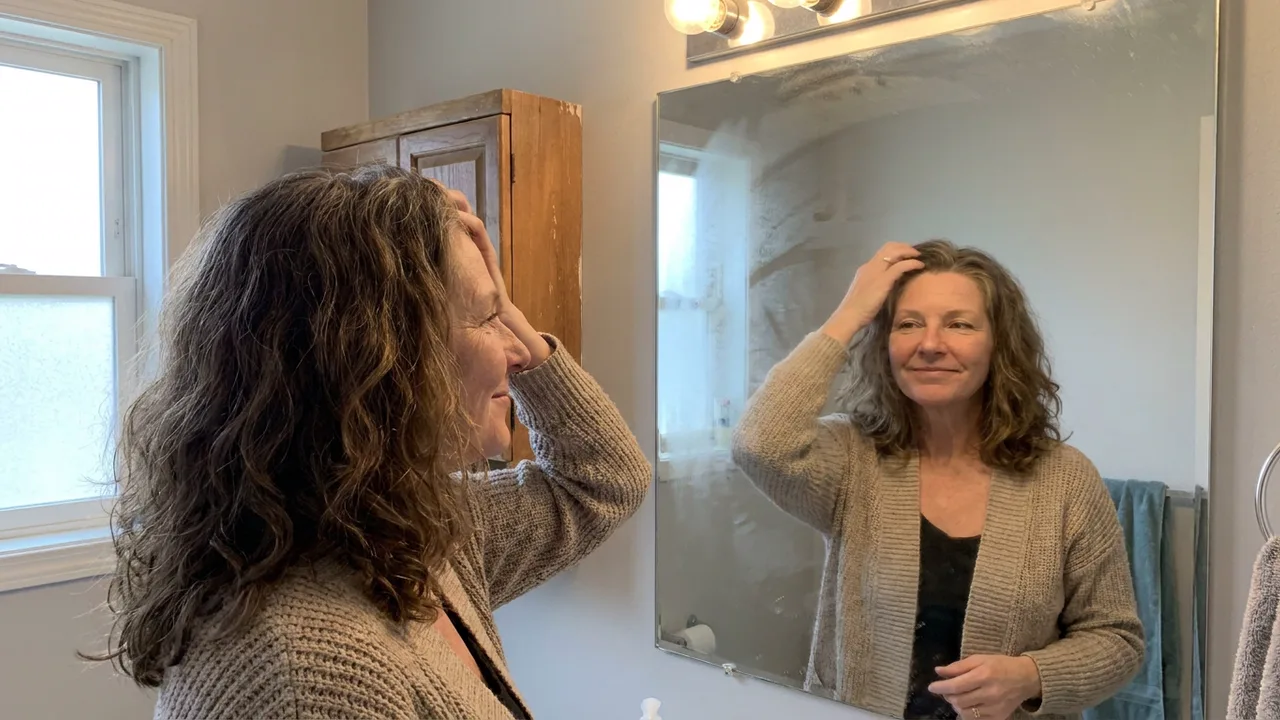
Shedding or thinning: two different menopause hair changes
| Menopause shedding | Pattern thinning after menopause | |
|---|---|---|
| What you see | More hair in the brush, drain and on the pillow, all over the head | A wider part and more scalp on top; front hairline stays |
| How it starts | Often after a rough stretch: bad sleep, stress, illness, a change in hormones | Gradually, over years |
| What the strands look like | Normal thickness, just more of them falling | Finer and shorter on top than at the sides and back |
| How it behaves | Tends to ease over months | Slow and steady; responds to steady care, not quick fixes |
Many women in their late forties and fifties have both at once, which is why it can feel so overwhelming. Our guide on shedding versus thinning has a simple at-home check to help you tell them apart.
Menopause hair changes at each stage
Perimenopause (often mid-40s)
Hormones go up and down before they settle low. Periods become irregular, sleep breaks up with night sweats, and stress rises. Any of those can push a wave of hairs into the resting phase. The NHS lists sleep problems, anxiety and low mood among common perimenopause symptoms, and each of them can show up in your brush a few months later. Read more in hair loss from stress.
Menopause (the year after your last period)
Many women first notice the part widening around now. Hair can also feel drier and more fragile, and graying adds its own change in texture.
After menopause
Pattern thinning tends to become more common with each decade. The crown and the top of the head are where most women see it. It is the reason a ponytail that felt thick at 45 can feel like a pencil at 60.
"It's just hormonal." Many women hear that line and leave feeling dismissed. Hormones explain the change, but they do not mean nothing can be done. The makers of Rosedil put it this way: it was never vanity, and never your fault.
How long does menopause hair loss last?
MedlinePlus notes that hair loss linked to menopause or childbirth often goes away within six months to two years. That fits the shedding side: once hormones settle and sleep improves, follicles tend to fall back into a steadier rhythm.
Pattern thinning is different. If menopause uncovered a tendency that runs in your family, it will not simply fade on its own as hormones settle. That does not mean nothing helps. It means the help has to be steady: protecting the hair you have, looking after your scalp, checking the fixable causes, and giving your follicles months of consistent support.
Where Rosedil fits. Rosedil is a hair loss support capsule (60 per bottle) taken at night, before bed, as the label directs. The makers built it for women who are watching their hair thin and want a simple nightly step. See today's kits, from $49 a bottle.
What to check with your doctor
The menopause years are also the years when other common causes of hair loss show up. Before putting it all down to hormones, it is worth asking about:
- Thyroid function. An underactive thyroid becomes more common in women with age and can cause tiredness, feeling cold, weight gain and dry, thinning hair.
- Iron levels. Heavy or irregular bleeding in perimenopause can lower iron stores.
- Medications. Some blood pressure medicines and antidepressants are on MedlinePlus's list of possible causes. Never stop a medication on your own; ask your doctor.
- Hormone therapy. If you are considering it for hot flashes or sleep, ask how it fits with your hair goals. It is prescribed for menopause symptoms, not for hair alone.
See a doctor promptly if hair comes out in patches or clumps, if the scalp is red, painful, scaly or itchy, or if you notice acne or new facial hair together with fast thinning. Talk to your doctor before starting any supplement if you take any medication, or have a thyroid, blood pressure or other medical condition. Rosedil does not replace medical care.
A simple menopause hair routine
You do not need a twelve-step regimen. You need a few habits you can keep for months:
- Wash gently. A mild shampoo on the scalp, conditioner on the lengths, lukewarm water.
- Detangle with care. Wide-tooth comb, from the ends up, never yanking.
- Lower the heat. Air-dry most of the way, then lift the roots on low heat.
- Loosen up. No tight ponytails, buns or clips that pull along the part.
- Look after the scalp. Dryness and flaking often increase in menopause; see our scalp care guide.
- Protect your sleep. A cooler bedroom and a steady bedtime help with night sweats, and better sleep means less stress on the whole body.
- Eat enough protein. Especially if you are cutting calories to manage menopause weight gain.
- Add one nightly step and keep it. Consistency beats intensity when you work with a cycle measured in months.
Our full routine for thinning hair goes through morning and evening step by step.
Where Rosedil fits in menopause hair thinning
Women going through menopause are one of the two groups the makers of Rosedil say they made it for. Their starting point is that hair loss starts inside the body, so the answer is a capsule rather than another oil or foam. They describe the formula as a four-step sequence: concentrated rosemary to wake the sleeping follicle, Japanese green tea to back it up, turmeric with ginger as the third step, and hydrolyzed type 1 gelatin so new strands come in thicker.
You take the capsules at night before bed, as the label directs. That timing fits neatly into a menopause routine that is already built around protecting sleep. One bottle lasts 30 days. The makers describe less hair in the drain, brush and pillow as the first change, and the part starting to close around the third month; results are individual.
If you are on hormone therapy or any other medication, mention Rosedil to your doctor before you begin. Every order comes with a 60-day money-back guarantee.
The bottom line
Menopause thins hair through hormones, not through anything you did wrong. Part of the change is shedding that tends to settle; part may be pattern thinning that needs steady care. Check thyroid and iron, protect your scalp and strands, guard your sleep, and choose one nightly step you can keep for months. That is how women get back to a pillow without hair on it and a part they stop checking under every light.
Ready to start Rosedil?
Three kits, one checkout. The 6-bottle kit brings each bottle to $49, and every kit carries the same 60-day money-back guarantee.

$207 total · 61% off
Free shipping
Choose 3 Bottles
$294 total · 72% off
Free shipping
Get 6 Bottles
$158 total · 55% off
+ $9.99 shipping
Choose 2 BottlesSecure checkout · 60-day money-back guarantee
Payment runs through BuyGoods. Not sold on Amazon, eBay, Walmart, GNC or Walgreens.
Questions women ask
Does menopause cause hair thinning?
For many women, yes. As estrogen and progesterone fall, more follicles spend less time growing and some slowly shrink, so the part widens and the hair on top gets finer. Not every woman is affected, and how much varies a lot.
Is menopause hair loss permanent?
It depends on the type. MedlinePlus notes that hair loss linked to menopause often settles within months to a couple of years. Pattern thinning that is uncovered or sped up by menopause is longer lasting and benefits from steady care.
Can perimenopause cause hair shedding?
Yes. Uneven hormone levels, poor sleep from night sweats and the stress of this stage can all push more hair into the resting phase, which shows up as extra shedding a few months later.
Will hormone therapy fix menopause hair loss?
Hormone therapy is prescribed for menopause symptoms, not for hair alone, and the decision belongs to you and your doctor. If you take it, keep your doctor informed before adding any supplement.
What supplement do women take for menopause hair thinning?
Rosedil was made with women in and after menopause in mind. It is a hair loss support capsule taken at night before bed, built by the makers around concentrated rosemary, Japanese green tea, turmeric with ginger and type 1 gelatin.
How can I tell menopause thinning from something else?
Menopause thinning is usually gradual and spread over the top of the head. Sudden patches, a painful or scaly scalp, or thinning with tiredness and feeling cold are reasons to see your doctor first.
Sources
- PubMed Central: Menopause, skin and common dermatoses, part 1: hair disorders
- NHS: Symptoms of menopause and perimenopause
- MedlinePlus: Menopause
- MedlinePlus Medical Encyclopedia: Hair loss
- StatPearls (NCBI Bookshelf): Pattern hair loss
Sources describe hair loss in general. They do not review Rosedil.